
HEXAFORCE / FORCE + SPATIAL STATE
12-axis force sensors.
Define every channel.
Combine six force/torque components with explicitly named state measurements for robot wrists and dynamic contact tasks. Specify the loads, mounting and timing as one engineering configuration.
Final model, ranges, assembly mass, output modes and supply terms follow the configuration-specific engineering response.
FIRST DECISION / NAME THE PHYSICAL QUANTITIES
Six wrench components. Six additional state channels.
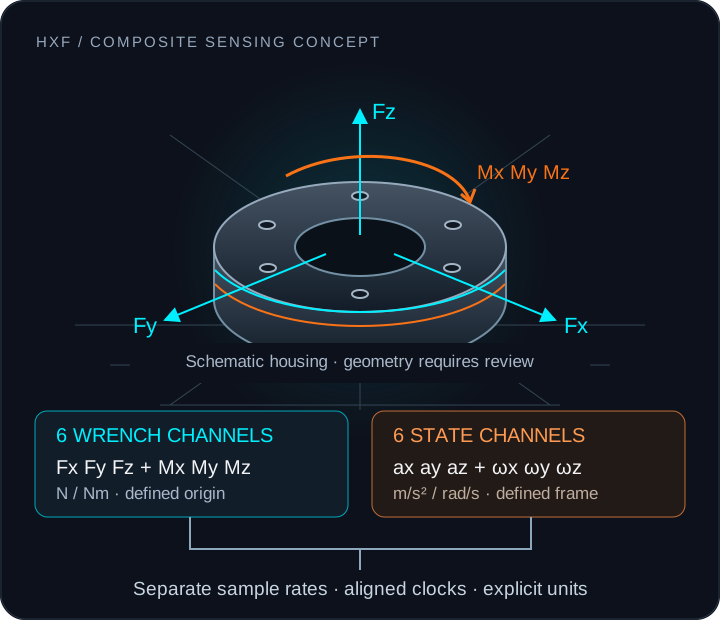
A wrench contains Fx, Fy, Fz and Mx, My, Mz. In one twelve-channel composite architecture, the additional outputs are three linear accelerations and three angular rates. Other force/acceleration designs use angular acceleration. Define the quantities before comparing a six-axis force sensor with a twelve-axis system.
| Architecture | Mechanical channels | Additional state outputs | Engineering decision |
|---|---|---|---|
| Six-axis force/torque | Fx, Fy, Fz · N Mx, My, Mz · Nm | State data, if present, must be separately defined | A calibrated contact-load measurement is the core requirement. Review HXF-WRT targets. |
| Force + acceleration + angular rate | The same six wrench components | ax, ay, az · m/s² ωx, ωy, ωz · rad/s or °/s | Force and tool-state acquisition in one assembly; confirm delivered rates, transforms and sample alignment. |
| Force + linear/angular acceleration | The same six wrench components | ax, ay, az · m/s² αx, αy, αz · rad/s² | Explicit angular-acceleration measurement or estimation requirement; confirm method, filtering and uncertainty. |
Three Euler angles or a quaternion can be derived outputs. Counting those fields does not create more independent force components. A supplier may retain the six-axis name while providing additional state data.
MOUNTING + PAYLOAD / DRAWING-LED REVIEW
Fit the complete sensing stack into the wrist
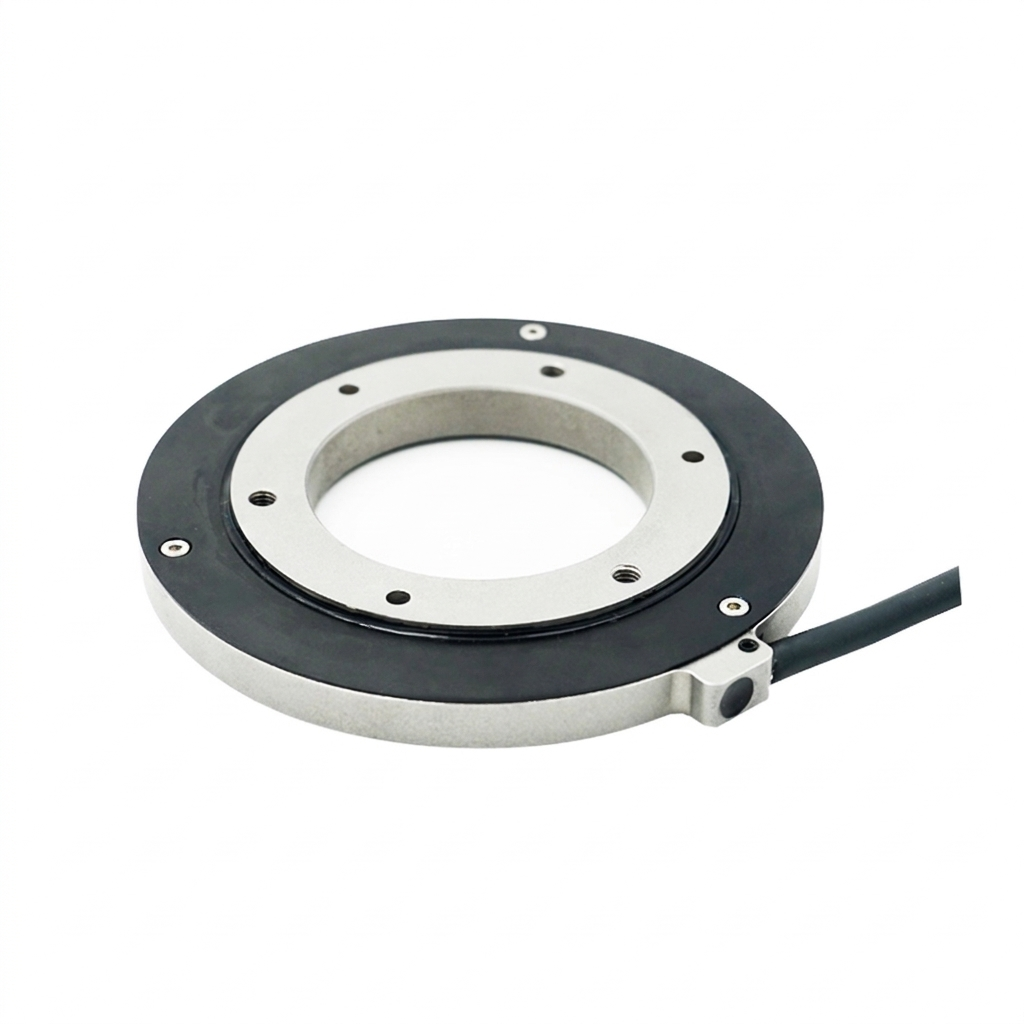
Choose the required six-channel load envelope first. Then review the composite module, both mating flanges, fasteners, cable exit and any external interface. A shared diameter does not establish a matching bolt circle, height or pinout.
- Mechanical envelope: maximum diameter, total stack height, pilot/bolt/bore geometry and cable bend clearance.
- Moving payload: sensor, adapter, tool and cable mass, center of mass and rotational inertia.
- Channel definition: positive axes, wrench reference origin, state reference point and transformation to the controller frame.
Preserve the contact-load requirement
Extra state channels do not replace six-channel calibration, combined-load verification, noise-at-bandwidth or temperature evidence.
Make sample age visible
A timestamped packet can contain signals acquired at different times. Request per-stream acquisition timing, latency and jitter.
Quote the complete acquisition path
Confirm power, connector, native output, converter if needed, firmware field map and host software as one configuration.
SAMPLE RATE ≠ PACKET RATE ≠ CONTROL RATE
A 2 kHz wrench stream can carry a 100 Hz state update
Illustrative planning example: at 2,000 wrench updates per second and 100 new state samples per second, the nominal periods are 0.5 ms and 10 ms. There are 20 wrench updates per state period. Repeating a state value in each packet does not provide 20 independent state samples.
Use the interface review to confirm acquisition rate, delivered output, filter delay, bus cycle and controller cycle separately. These example values are requirements arithmetic, not an HXF performance claim.
Check transport capacity before selecting the bus
Illustrative serial budget: a 73-byte frame at 115,200 bit/s with 8N1 framing needs 730 transmitted bits. The ideal upper bound is about 157.8 frames/s before gaps, commands or other overhead. A 2 kHz acquisition setting alone does not establish a 2 kHz complete-frame output.
73 bytes is one reviewed protocol example, not a universal twelve-channel frame. Confirm frame length, payload meanings, endianness, timestamp fields and firmware revision for the quoted configuration.
CHANNELS + LOADS + TIMING / ENGINEERING REQUEST
Prepare a twelve-channel configuration brief
State the measurements and timing you need. Leave unknown rates or skew blank. These are requested requirements; engineering confirms achievable values for the complete system.
ILLUSTRATIVE TASKS / DEFINE THE TEST BEFORE THE SENSOR
Three contact tasks that need different force/state evidence
A moving humanoid wrist
Separate contact-load needs from payload dynamics. Provide tool mass, center of mass, motion envelope and the permitted age difference between force and state samples.
Review separate wrist and ankle loads ↗Insertion during arm motion
Specify the smallest contact event to detect, allowed delay and vibration/filter conditions. Validate with an independent reference while the tool follows a defined trajectory.
Screen force and offset moment targets ↗Dynamic finishing or haptic research
Document the control loop, desired wrench frame, state source and estimator. Measure delayed or repeated samples before tuning the contact controller.
Compare the underlying six-axis load targets ↗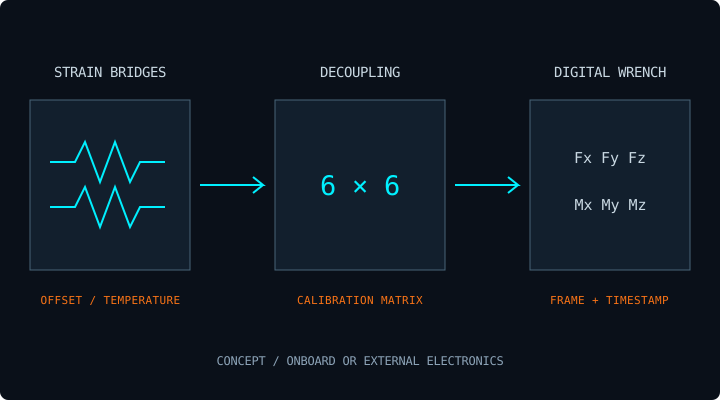
CALIBRATION + ACCEPTANCE / VERIFIED TOGETHER
Approve force, state and synchronization separately
For contact-load estimation during motion, the system also needs payload mass, center of mass, inertia, gravity convention, frame transforms and aligned timing. The presence of state channels does not establish automatic dynamic compensation.
- Wrench chain: serial-linked matrix, calibration temperature, combined-load limits, noise and uncertainty at a named filter setting.
- State chain: bias, scale, cross-axis behavior, orientation convention, drift and independent reference checks.
- Timing chain: timestamp meaning and origin, clock alignment, sample age, filter delay, dropped samples and repeat-value behavior.
- Complete assembly: static reference loads, moving-tool baseline and independent contact-load validation. Define acceptance thresholds before testing.
TWELVE-CHANNEL PROCUREMENT QUESTIONS
Resolve the quantities and timing before ordering
What does a 12-axis force sensor measure?
Specify the channel contract. One composite architecture combines Fx, Fy, Fz, Mx, My and Mz with three linear accelerations and three angular rates. Other force/acceleration architectures use angular acceleration instead. These are different physical quantities, not twelve independent force directions.
Do twelve channels provide better force accuracy?
Channel count does not establish force accuracy. Compare the six-channel calibration, uncertainty, noise at the working bandwidth, combined-load limits and thermal behavior. Additional state data can support a defined estimation workflow.
Is angular rate the same as angular acceleration?
Angular rate describes rotation speed in rad/s or degrees/s. Angular acceleration describes its rate of change in rad/s² or degrees/s². Differentiating rate requires a stated filter, sample interval and error budget. Request the actual output field definitions.
Does a 2 kHz force stream mean every channel updates at 2 kHz?
No. Force acquisition, state acquisition, fusion, transport and controller cycles can have different rates and delays. A faster packet stream can repeat an older state sample. Request per-stream timestamps, sample age, synchronization and measured delivered rates.
Can state data automatically remove gravity and inertial loads?
The estimator also needs the payload mass, center of mass, inertia, coordinate transforms, gravity convention and aligned timing. Confirm whether compensation runs in firmware or host software and validate it against independent reference loads.
Are twelve-axis HXF configurations available as approved stock models?
This page supports configuration review. The exact sensor, nominal ranges, total mass, mounting drawing, channel set, firmware, interface and supply terms must be confirmed in the written engineering response. No stock status or universal compatibility is stated.
Can I use EtherCAT, USB or ROS2?
Request the physical interface, gateway if needed, firmware-matched field map and delivered cycle timing. ROS2 integration needs explicit message fields, units, frames and timestamps; a connector shape or middleware name does not prove compatibility.
What should I send for a twelve-channel quotation?
Send simultaneous force/moment loads, maximum diameter, stack height and mass, robot/tool details, requested state quantities, separate force/state rates, permitted skew and acceptance criteria. Use the requirements form to preserve these details in the engineering brief.
PRIMARY ENGINEERING REFERENCES / REVIEWED 01 NOV 2026
Compare channel definitions in the original documentation
These references establish terminology and alternative architectures. They do not approve an HXF model, interoperability or supply commitment.
- ATI: six-component force/torque terminology ↗
- Bota Systems: integrated force and state sensing ↗
- Composite spatial-sensing product architecture ↗
- Research patent: force with linear and angular acceleration ↗
A research patent describes an architecture; it is not evidence of current commercial availability, calibration quality or an HXF manufacturing claim.
DRAWING + CHANNEL CONTRACT + WRITTEN QUOTATION
Send the complete twelve-channel requirement
Start with the channel and timing form above, or describe your custom requirements directly below. Engineering will confirm the exact configuration and documentation.
YOUR MAIL CLIENT / SAME ENGINEERING REQUEST
Send the selected model and specifications by email
The subject and message include the selected model, original reference, requested documents, loads and hardware options.
Read or manually copy the complete draft
To: inquiry@6axisforcesensor.com
Subject: HexaForce Engineering quotation — 6-axis sensing

Hello HexaForce engineering,

Request: Engineering quotation
Family: Please advise
HXF model / review target: Please advise
Original sensor / revision: Please advise
Application: Collaborative robot arm (UR, Franka, KUKA, Fanuc)
Target Fz (N) and Mxy (Nm): Please advise
Maximum OD and thickness (mm): Please advise
Preferred protocol: Help me select
Robot / tool / flange: Please advise
Quantity band: Please advise
Quantity: Please advise
Delivery country / timeline: Please advise
Requested documents: STEP CAD & mechanical mounting drawing; Connector / pinout / cable drawing; Configuration-specific English datasheet; Calibration, noise & crosstalk evidence; CAN-FD / serial / USB protocol documentation; EtherCAT ESI / PDO and cycle-time review; Formal quotation / proforma invoice
Digital decoupling / software: confirm the selected configuration and tested release
Options: None requested
Project notes:
Engineering acceptance requirements:
12-axis composite sensing — engineering configuration request.
Requested channel contract: 6 force/moment + 3 linear acceleration + 3 angular rate.
Requested wrench output rate: Not specified.
Requested state output rate: Not specified.
Requested maximum inter-stream skew: Not specified.
Requested frames / origins / clock: Not specified.
Acceptance requirements: Not specified.
Confirm drawing, calibration, firmware and protocol revisions; actual rates, latency, jitter, timestamp source and units.
Angular rate is not angular acceleration. Requested values do not establish hardware capability or a released SKU.

Full name: [enter name]
Work email: [enter email]
Organization: [enter organization]
Source page: /12-axis-force-sensors/
Please confirm drawings, capacity, output, calibration evidence, software scope, price and delivery before ordering.
The contact link carries technical selections. Personal contact details and project notes remain on this form.